Flying Drones in Japan: A Guide for International Clients
Japan has one of the world’s most structured regulatory frameworks for unmanned aircraft. For production companies, brands, and tourism boards planning aerial work here, understanding the basics in advance saves time and avoids delays on shoot day. Below is an overview of the key systems and laws that govern commercial drone operations in Japan — and how cubic-tt (島空撮) stays fully compliant with all of them.
1. Aircraft Registration
Since June 2022, any unmanned aircraft weighing 100g or more (including battery and accessories) must be registered with Japan’s Ministry of Land, Infrastructure, Transport and Tourism (MLIT) before it can legally fly. Registration is completed online through **DIPS2.0** (Drone/UAS Information Platform System), MLIT’s official web portal, which is also available in English. Once approved, each aircraft receives a registration ID that must be clearly displayed on the airframe, and the aircraft must broadcast that ID via a Remote ID module during flight so its identity and location can be verified in real time. Registrations must be renewed every three years.
2. Pilot / Operator Account Setup
Before applying for any registration or flight approval, an operator first creates an account on DIPS2.0. This account is the hub for the entire process: registering aircraft, applying for flight permissions and approvals, and filing flight plans ahead of each operation. Non-Japanese applicants can create accounts and register aircraft using an overseas address and passport, though in practice, working with a locally registered and certificated operator — like cubic-tt — removes friction from this process entirely for visiting productions.
3. Flight Permission and Approval Applications
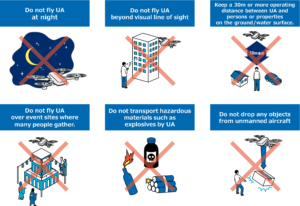
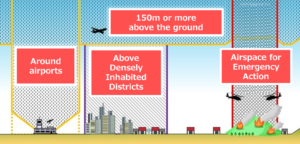
Japan’s Civil Aeronautics Act requires prior permission or approval for what is defined as a “Specified Flight” — for example, flying over densely inhabited districts (DID), at night, beyond visual line of sight, over 150m in altitude, or near people and property not involved in the operation. Applications are filed through DIPS2.0 and reviewed by the Civil Aviation Bureau. Approved operators with a strong safety record can apply for standing, area-wide, or extended-duration permissions rather than filing a new request for every flight — which is the basis of cubic-tt’s nationwide flight permits from the Osaka Aviation Bureau.
4. National Skill Certification
Introduced as a formal national qualification in 2022, Japan’s Unmanned Aircraft Pilot Certificate comes in two tiers:
- **Class 2** — covers standard, lower-risk operations.
- **Class 1** — required for the highest-risk category of flight (Category III), such as operations over people or vehicles in populated areas without safety measures, and demonstrates the pilot has met the national government’s top standard of knowledge and flight skill.
cubic-tt’s principal pilot holds Japan’s **Class 1** certification and also serves as a completion examiner at a MLIT-designated registration organization — meaning we are qualified not only to fly at the highest certified level, but to assess and certify other pilots to that same national standard.
5. The Civil Aeronautics Act
This is the core aviation law governing where, how, and under what conditions drones may fly in Japan — covering airspace near airports, altitude limits, DID restrictions, night flight, beyond-visual-line-of-sight operation, and the registration and Remote ID requirements above. It is the law most people mean when they refer generally to “drone regulations” in Japan.
6. The Small Unmanned Aircraft Flight Prohibition Act
This is a separate law from the Civil Aeronautics Act, and the two are easy to confuse. Rather than governing general flight safety, this act designates strict no-fly zones around specific high-security sites — the National Diet Building, the Prime Minister’s Official Residence, defense facilities, nuclear power stations, the Imperial Palace, and foreign embassies. Flying in these zones, even briefly, generally requires facility-administrator consent and 48-hour advance notice to the local police through the Public Safety Commission, and violations carry criminal penalties. In short: the Civil Aeronautics Act asks “is this flight being conducted safely,” while this Act asks “is this specific piece of airspace off-limits entirely.”
7. The Radio Act and the Technical Conformity Mark
A drone is not just an aircraft — it is also a radio-transmitting device, since its control link and video feed both operate over radio frequency. Under Japan’s Radio Act, any radio equipment used domestically must meet Japanese technical standards and carry a Technical Conformity Mark (giteki mark), unless it qualifies for one of a narrow set of low-power exemptions. Equipment bearing this mark can operate without a separate radio station license; equipment without it generally cannot legally transmit in Japan at all.
8. Links
MLIT UAS website — https://www.mlit.go.jp/koku/info/en/
NPA UAS website — https://www.npa.go.jp/english/uas/uas.html
NPA GSI Maps– https://maps.gsi.go.jp/#10/34.410309/134.206238/&base=std&ls=std%7Cdid2020%7Ckokuarea%7Cdrone_rz_yz&blend=0&disp=1111&lcd=drone_rz_yz&vs=c1g1j0h0k0l0u0t0z0r0s0m0f1
Warning: Drone flights are prohibited within the yellow area, including the red area shown. Flying without proper authorization may result in arrest.
Note: Starting July 14 2026, the no-fly zone around important facilities will be expanded from 300m to 1000m.
*This page is intended as a general orientation for international clients and partners, not as legal advice. Requirements can change, and every production should confirm current rules for its specific location and flight profile directly with MLIT or with cubic-tt during pre-production planning.*